
Skip to product information
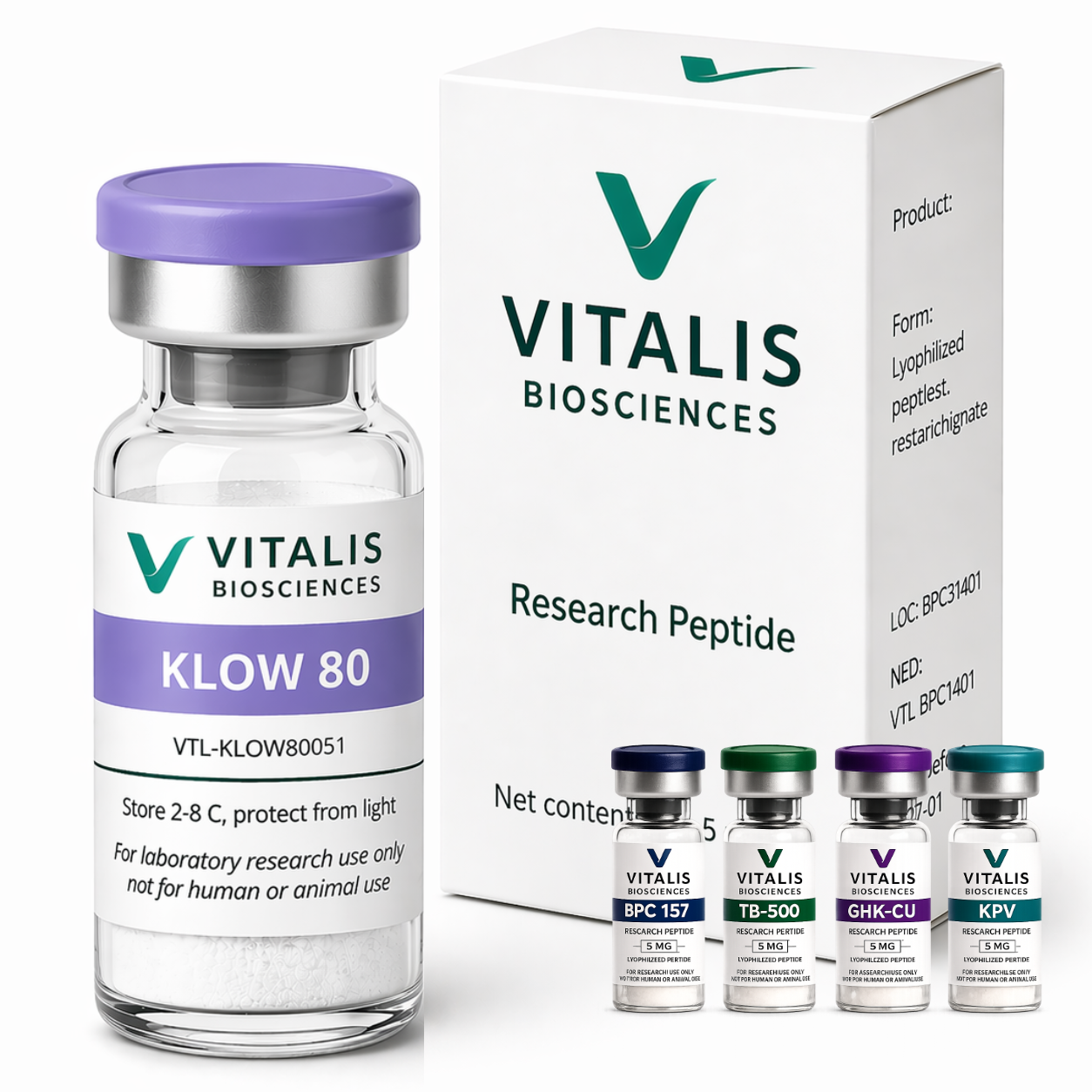

KLOW80 Blend
Sale price
$189.99 CAD
Regular price
$199.99 CAD
KLOW Blend 80
KLOW Blend is a research peptide blend combining:
-
BPC-157 (10 mg)
-
TB-500 (10 mg)
-
GHK-Cu (50 mg)
-
KPV (10 mg)
Designed for laboratory research exploring how multiple peptide signals interact together, rather than in isolation. The blend is formulated to allow researchers to study synergistic peptide signaling and pathway overlap, rather than single-compound behavior.
For laboratory research use only.
Available concentrations: 80 mg (blend total)
Peptide Classification
Product Type: Multi-peptide research blend
Component Types:
-
Synthetic pentadecapeptide (BPC-157)
-
Synthetic thymosin beta–derived peptide fragment (TB-500)
-
Copper-binding tripeptide (GHK-Cu)
-
Synthetic tripeptide (KPV – Lysine–Proline–Valine)
Source: Synthetic (laboratory-produced)
Physical Form: Lyophilized powder
Analytical Purity: >99% (HPLC, blend average)
Research Context
KLOW Blend is used in laboratory research to study how multiple short peptides function together to influence normal cell communication, signaling balance, and tissue-level responses.
In research settings, scientists are exploring how this blend interacts with pathways involved in:
-
How cells repair, organize, and renew themselves
-
How connective tissue and epithelial structures maintain integrity and resilience
-
How cells communicate during inflammatory signaling and immune response modulation
-
How peptide signals influence collagen, extracellular matrix, and cytoskeletal dynamics
-
How combined biological signals affect cellular coordination and signaling efficiency
Put simply, research focuses on how peptide combinations may influence overall tissue signaling balance, repair communication, and inflammatory pathway behavior, rather than targeting a single isolated mechanism.
All studies involving KLOW Blend are conducted in laboratory and experimental models only, with the goal of understanding biological mechanisms and peptide interaction, not treatments or outcomes.
Handling & Storage
Storage Conditions: 2–8 °C, protected from light
Stability: Lyophilized format supports extended stability when stored properly
Reconstitution: For laboratory research protocols only, using appropriate sterile laboratory techniques

Storage Conditions
2–8 °C, protected from light

Stability
Lyophilized format supports extended stability when stored under recommended conditions

Reconstitution
For laboratory research protocols only, using appropriate sterile laboratory techniques
Complimentary Products
Why Choose Vitalis Biosciences
See how we compare to other suppliers
| Most Suppliers | Vitalis Biosciences | |
|---|---|---|
| Canadian GMP Manufactured | ✕ | ✓ |
| Canadian Raw Ingredients (API's) | ✕ | ✓ |
| Canadian Certified Lab Testing | ✕ | ✓ |
| Accessible Original Lab Results | ✕ | ✓ |
| Purity Gurantee | ✕ | ✓ |
| Payment Methods | Bit-Coin & E-Transfer | Major Credit Cards & E-Transfer |
| Live Support | Email Only | Canadian Phone & Email Support |
| Shipping speed | 5-7 Days | 2-3 Days |


